Builds / recipe
Build your own job search filter
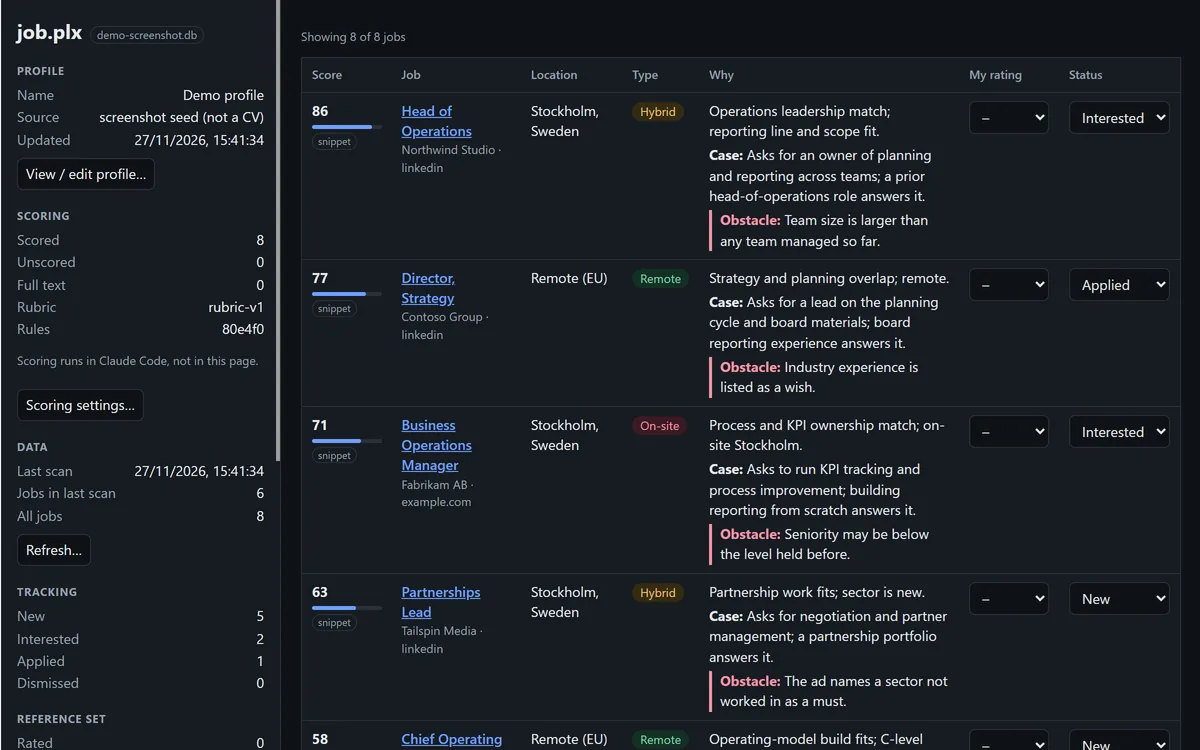
A little job-hunt tool that runs on your own computer. Feed it your resume, skills and preferences to build your profile, then paste links to job ads (or import batches from sources you're allowed to use). The engine scores each one for how strong your case is to apply, and a local page shows the ranked list where you keep track of what you've seen, dismissed and applied to. Over time, as you rate jobs, the engine gets better at identifying the most relevant ones.
- Status
- In progress
- Size
- Large build, milestone by milestone
- Runs in
- Claude Code, in an empty project folder
What it will ask you
- Your CV, which it turns into a profile you can check
- Where you work: home area, remote, hybrid, relocation
- Which kinds of work you never want
- Which languages and licences you have
About a dozen questions in all, each with a default, so "keep default" always works. Every answer stays editable in the app afterwards.
What's already decided
- The score is an outside view of the case for applying, with no encouragement added.
- Only hard facts and your stated preferences can cap a score.
- The scorer sees only its own packet, never the rest of your session.
- Every score records which model and which version of your rules produced it.
Before you start
- You need
- Claude Code, Python 3.11 or newer with the uv package manager, and a browser.
- Usage
- Scoring runs inside your Claude Code session, so there's no API key to set up.
How to use it
- Copy the recipe with the button below.
- Paste it as the first message in a new Claude Code session, in an empty folder.
- Answer the questions, say yes to the plan, and Claude builds it.
Read the whole recipe
/anthropic-skills:grill-me
Build me a personal job-hunt tool as a code project in a new repository, tailored to me. It collects job ads (links I paste, and optionally batch files of jobs from sources I am allowed to use), scores each one for how strong the realistic case is for me to apply, and shows a ranked list in a local page with notes on what I have seen, rated, dismissed or applied to. Claude Code itself does the scoring, with no API key. The rest of this message describes it. Interview me first, then write the spec and the milestone plan with acceptance tests, get my yes, and build one milestone at a time. After each milestone, show me what works, run its tests, and wait for my go-ahead before starting the next.
If the grill-me skill is not available, run the same process yourself: ask the interview questions below a few at a time, write a short spec with milestones and acceptance tests, wait for my yes, then build.
0. Check before the interview
This needs Claude Code (it uses skills and a sub-agent), Python 3.11 or newer with the uv package manager, and a browser. Check what is installed and tell me what is missing, before asking any questions. Ask me before installing anything, creating any account or adding any key. Never ask me to paste a secret into the chat. This project needs no API key and must not add one: scoring runs inside my Claude Code session.
1. What to ask me
Keep to about 11 questions, a few at a time. Offer a default for each so I can say "keep default". Sections 2 to 10 are already decided, so do not ask about them. Every answer becomes an editable setting or file value, never a constant in logic. Anything you decide for me without asking goes in the spec as an assumption and is editable too.
- What should the app be called? Default: "Job Filter".
- Which operating system do I use? The start script for the viewer follows from it (default: the one you detect). Python with uv is the default stack.
- What look do I want? Default: a clean dark theme. Layout is decided in section 5.
- My CV: paste it or give a file path. You turn it into a profile in markdown (headline, summary, experience with dates and results, skills), show it to me and store it. A different headline than my CV's can be given.
- Where do I work? Ask four things: home area or areas; remote roles acceptable (default yes); hybrid or on-site only inside my home area (default yes); willing to relocate (default no). If I say yes to relocating, there is no location cap.
- Which kinds of work do I never want (my avoid list)? Default: empty. These become part of my rules file.
- Which languages do I work in, and which professional licenses or qualifications do I hold? An ad that requires a language or license I lack caps the score. Default: English only, no licenses.
- Part 2 of my rules (obstacles, section 4). Default: the generic list in section 4. I may add or delete lines.
- Which model scores job ads in full, and at which effort? Default: sonnet at medium effort, which reads ads almost as well as opus at lower cost. Opus is a one-line switch in Settings. Anthropic models only. Model names change, so the switch exists for longevity, and the model id the scorer reports is recorded with each score.
- Numbers. Default: keep the values in sections 3 and 6 (full-text cutoff 25, case cutoff 55, batch of 10, 6 examples, every 4th rated job held back, 2-hour freshness window, confirm above 30 jobs or 4 packets, reference-report cutoff 45). They are starting points: tune them with the reference report.
- Which language for the interface, rules text and score reasons? Default: English.
2. Core rules
- The score is an outside view of the case for applying. It is not a prediction of whether I will reject the job. I use it to take a second look at jobs I would talk myself out of. The scorer must stay honest: no inflated scores, no encouragement. The case rests on the ad's text and my record.
- Only hard facts and stated preferences cap a score. Never turn a reason I give for rejecting a job into a rule that lowers scores. That was tried in the original: rules built from my rejection reasons buried jobs I wanted. Confidence calls such as "no experience in this industry" are weighed and named as the obstacle, never capped.
- The scorer sees only its packet. A sub-agent scores full ads from a fixed packet (rubric, my rules, a few jobs I rated, my profile, the jobs). The session knows things about me that the scorer must not use, so the session never does the full-text pass, and never writes the scorer's prompt.
- Every score can be traced. A label on each score records the model, rubric version and a fingerprint of my rules file, so changes can be judged later.
- One writer, never blank, never silent. Jobs enter the database through one function. A known job is never overwritten with an empty value. Nothing is rescored unless I ask, my profile changed, or the full-text pass of an import calls for it.
- The viewer shows, it does not score. It also edits my own scoring settings (section 5), and nothing else about the scorer.
3. Data and scoring
Storage. A local SQLite file that git ignores. Tables: profiles; jobs (identity is source plus the source's own id, with title, company, location, work type of remote, hybrid or onsite, url, description, posted date, first-seen time that never changes, last-seen-by-an-import time, raw payload); scores (one per job and profile: 0 to 100, a reason, the label, scored-at, a case text, an obstacle text); applications (tracking status per job: new, interested, applied, dismissed; no row means new); ratings (section 6); imports (one row per batch import of a source, with a time and job count).
Job intake. All sources convert to one neutral job format, and one function writes the jobs table. It is idempotent: a known job keeps its row, first-seen time, scores and status. An empty field never replaces a stored value. "Last seen" is set only by batch imports. A pasted job keeps its old value, or an empty one if no import has seen it.
Batch import. A batch file is a JSON list of jobs in the neutral format, with a source name, from a source I am allowed to collect from (for example a job board's own export, feed or alert). This project ships no collector for any site, and must not build one for a site whose terms forbid automated collection. An import script checks the file (valid JSON, each job has a source id and a title, no duplicate ids), ingests it through the one writer, and records an import row. Batch import is optional: the tool works with pasted jobs alone.
Freshness. An import writes an import row per source. A job counts as "current" when an import saw it in the 2 hours up to that source's latest import (the buffer treats repeated imports in one sitting as one). A pasted job never moves that window, and a source that was never imported is never filtered by it.
Pasted jobs. A pasted URL is fetched with a plain web request, no browser. Read the page's schema.org JobPosting block. Tracking parameters (utm, trk, ref, fbclid and the like) are stripped, other query parameters stay because some sites carry the id in them, and a URL fragment that routes inside a site is kept. Where a site's URL carries its own job id, the job resolves to that id, so it matches the same job from an import of that source. The same job on two sources is not matched and shows twice. If the page cannot be parsed or has fewer than 200 characters of text, the session reads it in the browser and loads a small JSON file instead. Never invent fields. A pasted job is marked interested, which also keeps it visible regardless of the freshness filter. I have read the ad and accepted its location, so a pasted job gets no location cap and no work-type markdown. Its case and obstacle are always written, whatever its score.
Rubric (versioned file). One integer 0 to 100, absolute, not ranked against other jobs. Bands: 85 to 100 strong case, role, seniority and domain match; 70 to 84 good case with one clear obstacle; 50 to 69 a real case with two obstacles, worth opening; 25 to 49 thin case; 0 to 24 no realistic case. Weigh seniority: mark down junior or purely executional roles. A promoted listing is judged on the role alone, and on the role rather than the employer's brand. A missing or boilerplate description caps at 60. The reason is one line, 12 words at most, naming the main match and the main obstacle. Jobs at or above the case cutoff (55) also get a case (two sentences, 50 words, what the ad asks and what in my record answers it) and an obstacle (one sentence, 35 words, what most stands in the way and whether the ad calls it a must or a wish). The rubric file holds a version number and version history. A rubric change bumps it.
Rules file (mine, unversioned). Part 1, caps: an avoid list (cap 30), hard requirements for a language or license I lack (cap 30; a requirement the ad calls a plus is never a cap), and location (cap 15, when the ad requires a physical base outside my home area, on-site or hybrid; a remote role for an employer abroad is fine). The caps are starting points. When several caps apply, the lowest wins. Part 2, obstacles to weigh, never caps. A rules edit never rescores anything. The fingerprint is six hex characters of a hash over the file with line endings, trailing spaces and any BOM ignored; an empty file is an error.
Two passes. 1) Snippet pass, in the session: every new job from an import is scored from title, company, location, work type and its first 600 characters. It only decides who gets a full read. A snippet is good at showing a job is wrong and poor at showing it is right, so when it does not rule a job out, score it at the full-text cutoff or higher. A job matching the avoid list or a hard requirement scores below the cutoff, so it is never read in full. 2) Full-text pass: every job scored at or above the cutoff of 25 that was seen by the latest import and is not yet labeled full-text goes to the scorer, which replaces the snippet score. In the original, 31 percent of a batch's jobs were under 25 and none of them reached 45 on full text. Snippets were wrong at the top, with three of the six highest snippet scores falling 24 to 36 points on full text. This is the only rescoring a run does.
Scorer packet and collection. A script writes one packet file per batch. Jobs are split into the fewest batches of at most 10 and the batches are evened out in size. Each packet holds: the rubric from its Score section to its Case section, my rules, up to 6 jobs I rated as examples (taken in turn across the five levels so they span my range; within a level, jobs with a note first; each shown as title, company, location, my level, my note and the first 800 characters of the ad; never the job being scored; every 4th rated job by id is held back and never shown, so it can test a change; ratings on any older scale are skipped), my profile, and the jobs in full. It ends with the output shape: JSON with the scorer's model id and a list of job id, score, reason, case, obstacle. A manifest records the packet hashes, the rubric version and the rules fingerprint. Collection checks every output: the job ids equal the packet's, each score is an integer 0 to 100, each reason is non-empty (warn above 12 words), a high scorer without case or obstacle warns, the model id must be plain characters (else it is stored as unknown-model, because the scorer reads ad text from the web), packets scored by different models are not merged, and collection refuses if the rules file changed after the packets were built. A failed or missing packet is retried once in a fresh build, which picks up only jobs still lacking a full-text score. If it fails again, those jobs stay on snippet scores and I am told.
The scorer agent. A Claude Code sub-agent defined in the project, with tools limited to reading and writing files, not loading the project's instructions file, and taking only two lines as input: the packet path and the output path. The model and effort lines at the top of its file are the model switch (opus, sonnet or haiku, or a full model id; effort low, medium or high). Do not add context, hints or a model override when calling it. If the agent type is not yet loaded, fall back to a general sub-agent with the same model and the same instruction to read the packet only, and tell me.
Saving scores. From a JSON list. Validate every row first (known job id, no duplicates, integer 0 to 100, non-empty reason, case and obstacle cut to 600 characters), then write all rows or none in one transaction. Existing scores are skipped and counted unless an overwrite flag is passed, and a dry run reports without writing. The label is passed in as who scored plus the rubric version, for example "model/rubric-v10", and the script appends "/rules-" and the fingerprint itself. A full-text label ends with "/full-text" last. Write the JSON with a file tool, never an inline shell heredoc, because quotes break it.
Measured behaviour of scoring (starting facts, original numbers). Scoring a job alone gives 10 to 12 points more than scoring it in a batch, so the batch size is part of the configuration. Repeat noise is about 5 points and a model switch moves about 4 on average, so score differences under about 8 carry no meaning. Different models read the avoid list differently, so check a switch against rated jobs. A sub-agent call has about 65,000 tokens of fixed overhead plus about 8,000 per job in a batch.
Usage guard (added, not in the original). Before the full-text pass, say how many jobs and packets will run and ask for a yes if there are more than 30 jobs or 4 packets. Both limits are settings.
4. My rules, generic start
Part 2 starts with these obstacles, which are weighed from outside by how prominent the ask is in the ad and what else in my record outweighs it, and are named as the obstacle, never capped: the ad asks for experience in a named industry I have not worked in; a CEO or turnaround role in an industry where I have not held an operating role; a required background such as years at a top-tier consulting firm; a public-sector role that asks for experience from similar agencies; a role pitched at far fewer years than I have. I can edit these freely.
5. The viewer
A local web page, served by a small local server (FastAPI is the default). A health endpoint returns status. The page is served with no-cache headers (a browser showed a stale copy for hours in the original). Escape every job, model and user text before it is shown. English or my chosen language for all text.
Left sidebar sections: Profile (name, source, updated, a button to view and edit the profile markdown; name and markdown cannot be saved empty; unsaved changes ask before discarding); Scoring (scored and unscored counts, a note that scoring runs in Claude Code, a Scoring settings button); Data (time of last import, jobs in last import, all jobs, and an Import button that opens instructions to run a batch import in Claude Code); Tracking counts; Reference set (rated, to rate, filter, and a "Hide scores while rating" checkbox that hides scores, disables score sort and minimum score, and sorts by id so I rate blind); filters for status (all except dismissed by default, new, interested, applied, dismissed, all), source (with counts), "current only" (checked by default), minimum score, and work type. A text filter searches title, company, location, reason, case, obstacle and source. Sort by score (default), freshness, title, company, work type, location, my rating or status.
Main table, one row per job, columns Score (with a bar), Job (linked title and company, source), Location, Type (colored distinctly for remote, hybrid and on-site), Why (the reason, and for high scorers the case and the obstacle, with the obstacle visually marked), My rating, Status. A status drop-down on each row. A rating drop-down on each row. Dismissed jobs are hidden by default and stay dismissed when they reappear in later imports. A job outside the freshness window is hidden by the filter unless it has a status of interested or applied.
Scoring settings dialog. Edits exactly three things: my rules text (not empty, 20,000 characters at most), the five numbers (whole numbers 0 or more; batch size above 0; cutoffs at most 100), and the scorer's model and effort lines. It cannot edit the rubric or the scorer's instructions, because the local server must not be able to rewrite what the scorer is told. Writes are refused when the request's Origin names another site or another port. A save changes files, does not commit and does not rescore. The dialog says so, and shows how many stored scores were made under the current rules fingerprint. At the start of a Claude Code session, check git status for changes to these files, tell me, and offer to commit them. A value already in the agent file, such as a hand-set effort, survives a save that changes only the model, and only the settings block is rewritten, byte for byte otherwise.
6. Tracking and ratings
Status per job: new, interested, applied, dismissed. A rating records how far a job got with me: 5 applied, 4 opened it and thought hard, then decided against, 3 opened it and decided against quickly, 2 rejected on title or company, 1 never show again. A rating has an optional note of 200 characters. Rating 1 also dismisses a job whose status is still new. Moving a job off level 1 undoes that dismissal only if the status is still dismissed. An interested or applied job keeps its status. Clearing a rating keeps the job queued for rating and clears its note. A queue script puts a stratified sample of 12 top-scored and 13 spread across the rest (from jobs seen by the latest import, or from all jobs if nothing was ever imported) into my to-rate list, and never sets a rating for me. After the first full report, offer to queue about 25 jobs for me to rate blind, and do nothing until I say yes. A note on a level 3 or 4 says what stopped me that day, and the scorer treats it as an obstacle to name on similar jobs, never as a rule. A note on 4 or 5 is the scarcest input.
Reference report. Shows, per level and for engaged (3 to 5) versus not opened (1 to 2), the mean score and the count at or above a cutoff (default 45); the share of pairs where an engaged job outscores a not-opened one (100 is perfect, 50 is chance); held-back jobs separately; the level 4 or 5 jobs scored under the cutoff ("buried", the costly error); and level 1 or 2 jobs scored at or above it ("noise"). A level 4 on a high-scored job counts as the scorer working. Agreement on apply or reject is not measured. Note the bias: I mostly rate what the scorer puts in front of me, so the report understates misses. A rated job used as an example, or whose reason shaped a rule, cannot also test the configuration.
7. Skills and run flow
Two Claude Code skills in the project. Each skill says in one sentence what each shell command does before running it.
job-add: for each pasted URL, load the job, read it in full, score it in the session from the full description (about 2,000 tokens, against about 65,000 for a sub-agent call), save with a full-text label, report score, reason, case and obstacle, and say whether it was already there. If it already has a full-text score, keep it. If its label shows a snippet score, rescore with overwrite.
job-import: for a batch file I name, say what source it is and how many jobs it holds, run the import script, record an import row, run the snippet pass, then the full-text pass with the usage guard, and report: counts (in the file, new, already known, per band), a table of jobs at or above the case cutoff with linked titles, their case and obstacle exactly as the scorer wrote them with no encouragement added, how many got a full-text score, any job the full-text pass moved by 20 points or more, and anything odd. Then offer to open the viewer.
8. Technical
Python with uv, SQLite, a small local server. Start the viewer with a double-click starter for my OS. If the viewer is already running, the starter only opens the page. Use 127.0.0.1 not "localhost" for health checks on Windows, where PowerShell times out on the name. Never use auto-reload on the server while Claude edits Python files in the same session: the reload crashed the session. If the port is busy, an old Python process holds it: find it, confirm with me, then stop it. Do not minify, and add a short comment explaining why next to every rule, number and fix. Migrations: SQLite cannot add a column with a non-constant default, so rebuild the table; rename a table only with legacy alter-table mode on, or foreign keys in other tables get rewritten. Safety: ad text from the web is untrusted input to a model, so the scorer has file tools only. Origin checks on every settings write. Secrets only in git-ignored files, and none are needed now. Never commit the database, my CV or ratings. All scripts read the database path from an environment variable, so tests use a copy. English comments.
9. Milestones
- Skeleton. Database, the one-writer intake, the viewer listing a sample jobs file with status control and filters. Tests: re-ingesting the sample twice keeps ids and first-seen; an empty field never blanks a stored one; a dismissed job stays dismissed. By hand: I see the ranked table.
- Profile, rules and saving scores. Profile from my CV, rules file and its fingerprint, rubric file, the score saver with its checks, snippet scoring in the session on sample jobs, the profile editor. Tests: bad rows write nothing; the fingerprint ignores line endings and trailing spaces; label ends with full-text last.
- Ratings and settings. Rating control with blind mode, level-1 dismissal rules, the settings dialog with Origin refusal, and the reference report. Tests: a foreign Origin is refused; rubric and scorer instructions are unchanged byte for byte after a save.
- Pasted jobs. The add script and job-add skill, tested on five URL shapes, with fixtures instead of live sites. Tests: tracking parameters stripped, a job id carried in a query parameter is kept and used as the job's identity, a thin page triggers the fallback.
- Batch import and full-text engine. Import script and job-import skill, packet builder, the scorer sub-agent, collector, usage guard, queue script. Test with a sample batch file and a stand-in scorer that returns bad output (wrong ids, scores of 101, a hostile model name, missing case); then one real batch with my go-ahead. Tests: importing the same file twice keeps first-seen and updates last-seen; a malformed batch file writes nothing; held-back jobs never appear as examples; collection refuses after a rules change.
10. Definition of done, for every milestone
Write automated tests for the logic, using stand-ins for the scorer and for web fetches that also return bad output. Run them and show me the result. Work on a branch and commit with a message that says why. Report plainly what you tested and what you did not. Never commit secrets or my personal data, and never push or deploy without my go-ahead. If you drive a headless browser, launch it so it never asks for an OS keyring or password (Chromium: --password-store=basic --use-mock-keychain).
At the end, walk me through a real run: add one pasted job and see it scored in full with a case and an obstacle; then rate five jobs blind and open the reference report; then, if I have a batch file from a source I may use, import it and see the full-text pass run. Fix what fails.
Made with the recipe plugin. Back to Builds